
Israel's Real Estate Market: Built for Resilience
Few real estate markets have been tested as frequently - or as seriously - as Israel's.
In less than 80 years, Israel has built a modern country and a globally significant property market virtually from the ground up. It has done so while facing wars, terrorism, economic pressure, a global financial crisis, a pandemic and, most recently, the multi-front war that followed October 7, 2023.
Yet over more than five decades, sustained nationwide declines in Israeli property values have been remarkably rare. Periods of crisis have generally affected transaction volumes more than underlying values. Buyers may temporarily pause, but the country's fundamental need for housing remains - and the market has repeatedly stabilized, recovered and returned to growth.
This is the defining characteristic of Israeli real estate: resilience under pressure.
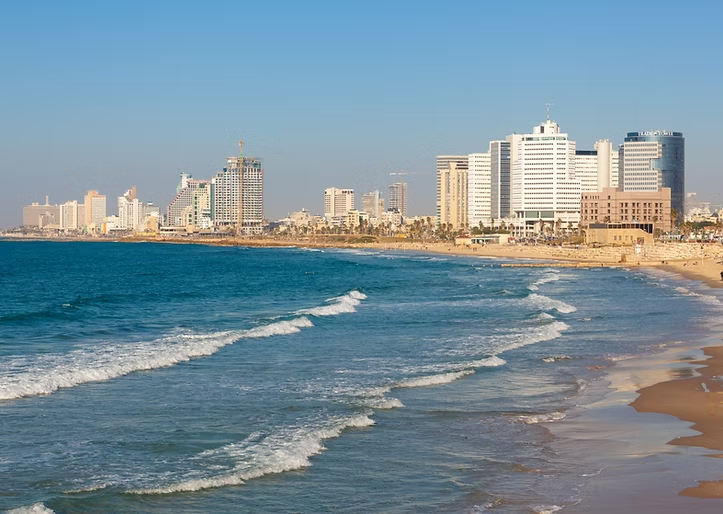
Israel's skylines have kept rising through Gulf War missiles, two intifadas, a global financial crisis, and multiple wars.
1991: Turning Crisis into Stronger Homes
During the 1991 Gulf War, Iraq fired dozens of Scud missiles at Israeli cities, including Tel Aviv and Haifa. Israel responded by permanently strengthening its residential building standards. Reinforced safe rooms, known as mamads, became mandatory in new homes.
Rather than weakening development, the crisis produced safer and more resilient housing. It established a pattern that continues today: Israel responds to national challenges by adapting its infrastructure, construction standards and cities.
2000-2007: Recovery After the Second Intifada
The Second Intifada and the global technology downturn created one of the most challenging periods for Israel's economy and property market. Even then, the decline in national property values was limited relative to the scale of the disruption.
As security and economic conditions stabilized, demand returned and the market entered one of its strongest periods of sustained growth. Areas directly affected by security events also recovered as buyers returned.
The lesson was clear: a crisis could temporarily interrupt market activity, but it did not eliminate Israel's underlying demand for homes.
2008-2010: Strength During a Global Housing Crisis
The 2008 global financial crisis caused housing markets across the United States and much of Europe to collapse. Israel moved in the opposite direction.
Nationwide property prices rose by approximately 24% between 2008 and 2010, while Tel Aviv prices increased by an estimated 41%.
Why Israel Was Insulated
Israel's conservative mortgage regulations, strict underwriting standards and loan-to-value limits protected its banking and housing systems from the excessive lending seen elsewhere. While other countries were recovering from housing crashes, Israeli real estate was demonstrating its structural strength.
Repeated Conflicts, Consistent Recovery
The same resilience remained visible through Operations Cast Lead, Pillar of Defense, Protective Edge and the 2021 conflict.
Each period created uncertainty and occasionally slowed transactions, particularly in areas closest to the fighting. Yet these interruptions were generally brief. Demand returned, activity resumed and the national market continued advancing.
This repeated pattern is important: temporary changes in transaction activity have rarely developed into prolonged nationwide declines in property values.
2020-2021: Growth Through the Pandemic
The pandemic brought lockdowns, economic disruption and significant restrictions on normal property activity. Nevertheless, Israeli home prices rose by approximately 9% nationally between the first quarter of 2020 and the end of 2021.
Jerusalem increased by approximately 12%, while Tel Aviv rose by nearly 11%.
Even during an unprecedented global emergency, Israel's population growth, limited land and persistent housing demand continued supporting the market.
2023-2024: Resilience After October 7
The period following October 7, 2023 became one of the greatest tests of Israel's modern economy and national confidence.
Property activity initially slowed as the country absorbed the shock. Yet the market did not remain frozen. Buyers returned, transactions resumed and prices rose by approximately 7-8% during 2024 - even as Israel continued facing an active multi-front war and considerable national uncertainty.
The recovery demonstrated the depth of Israel's housing demand and the enduring confidence of Israeli, international and diaspora buyers in the country's future.
Why Israeli Real Estate Remains Resilient
Several long-term forces help explain why Israel's property market has repeatedly absorbed major shocks:
From a New Country to One of the World's Most Valuable Property Markets
The long-term achievement is extraordinary.
In less than 80 years, Israel has progressed from a newly established country with limited infrastructure and resources to one of the world's most dynamic and valuable real estate markets. Tel Aviv and other leading Israeli cities have reached property values among the highest globally, while Tel Aviv prices rose by approximately 110% between 2012 and 2025.
Few countries have created this degree of housing demand, property value and international real estate prominence in such a short national history.
More remarkably, this appreciation did not occur during decades of uninterrupted peace and stability. It occurred through wars, terrorism, recessions, regional conflicts, a global financial crisis and a pandemic.
Israel did not build one of the world's most sought-after property markets because it avoided pressure. It built it while repeatedly overcoming pressure.
Resilience Is the Long-Term Story
The historical record does not show a market that rises in a perfectly straight line. It shows something more meaningful: sustained nationwide declines have been rare, interruptions have usually been temporary and the fundamental demand for Israeli real estate has repeatedly outlasted the crises confronting the country.
For long-term investors, that history offers a powerful perspective. Israel's population continues to grow, desirable land remains limited and demand for a home in Israel extends far beyond a single economic or security cycle.
In less than eight decades, Israel has built its cities, its housing market and its global property prominence virtually from zero. Its remarkable rate of appreciation is not only a story of rising prices - it is evidence of a country and a real estate market built to endure.
That is the resilience of Israeli real estate.
Past performance does not guarantee future results. Prospective buyers should evaluate each opportunity independently and consult qualified financial, legal and tax professionals before investing.
Take a Long-Term View
Speak with our advisors about how Israeli real estate could fit into your investment strategy.
Explore Your Options